How to make the program run faster: Difference between revisions
Jump to navigation
Jump to search
Klintsevicho (talk | contribs) |
Klintsevicho (talk | contribs) |
||
| Line 27: | Line 27: | ||
* Verify that the computer meets [[Technical specifications of InstalSystem 5 package|Hardware requirements]]. | * Verify that the computer meets [[Technical specifications of InstalSystem 5 package|Hardware requirements]]. | ||
* In the case of using laptop: | * In the case of using laptop: | ||
** It is important to remember that since mobility and energy efficiency are priorities in laptops, the TDP coefficients are significantly lower than in desktop computers. The result is a | ** It is important to remember that since mobility and energy efficiency are priorities in laptops, the TDP coefficients are significantly lower than in desktop computers. The result is a clock speed reduction of processors or graphics cards when a certain temperature is exceeded, thus limiting the performance of the laptop and, accordingly, reducing the performance of the software. | ||
** Pay attention to the energy saving plan set in Windows, because by default it is usually set to balanced or energy saving mode. | |||
This can significantly reduce performance. | |||
** When running on battery power alone, the default energy saving plan will almost certainly use only the integrated graphics card, which has much lower performance and reduces the clock speed as much as possible. | |||
Revision as of 11:28, 8 October 2025
| Product | InstalSystem 5 |
| Type of article | TIP&TRICK |
| Source for translation | 2019-12-06 |
Problem description
InstalSystem version 5 requires hardware of relatively high computing performance. The software tends to be slower on lower end machines. This is particularly apparent when large files are processed or when other applications run simultaneously. The scale of the problem also depends on the program functions and windows used.
A particular case in which the program may slow down is usage of complex DWG underlays containing a great number of layers and/or a lot of elements, and/or with large drawing dimensions.
Solution
General recommendations
- Verify that the computer meets Hardware requirements.
- In the case of using laptop:
- It is important to remember that since mobility and energy efficiency are priorities in laptops, the TDP coefficients are significantly lower than in desktop computers. The result is a clock speed reduction of processors or graphics cards when a certain temperature is exceeded, thus limiting the performance of the laptop and, accordingly, reducing the performance of the software.
- Pay attention to the energy saving plan set in Windows, because by default it is usually set to balanced or energy saving mode.
This can significantly reduce performance.
- When running on battery power alone, the default energy saving plan will almost certainly use only the integrated graphics card, which has much lower performance and reduces the clock speed as much as possible.
- Close all windows that are not needed (particularly the resource-intensive module 3D view).
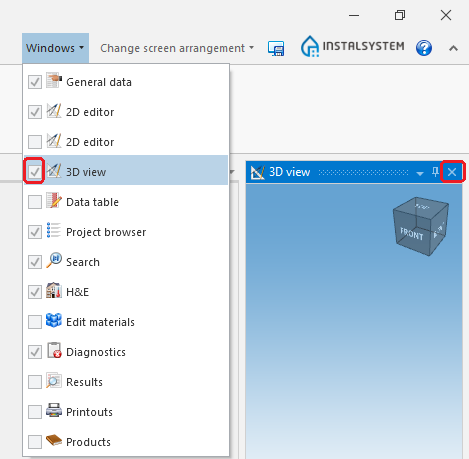
1. 3D Editor - Hide editing scopes that are not used.
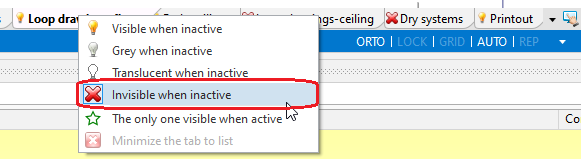
2.Hide edit scopes. - Exit all applications and services running in the background that are not used at the moment.


Complex DWG layouts
Having selected the DWG file, (in Underlay) for the layer on which the AUTO mode should not be working, it ios necessary to:
- deselect, in the Layers for AUTO mode field, a chosen position or
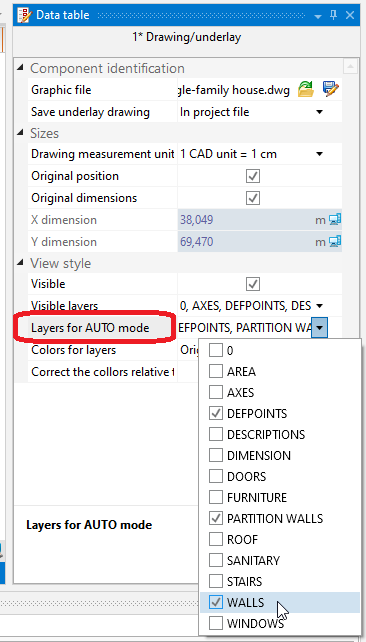
3. Layers for AUTO mode - with the right mouse button, click on the layout element and choose Disable AUTO for layer: %s.
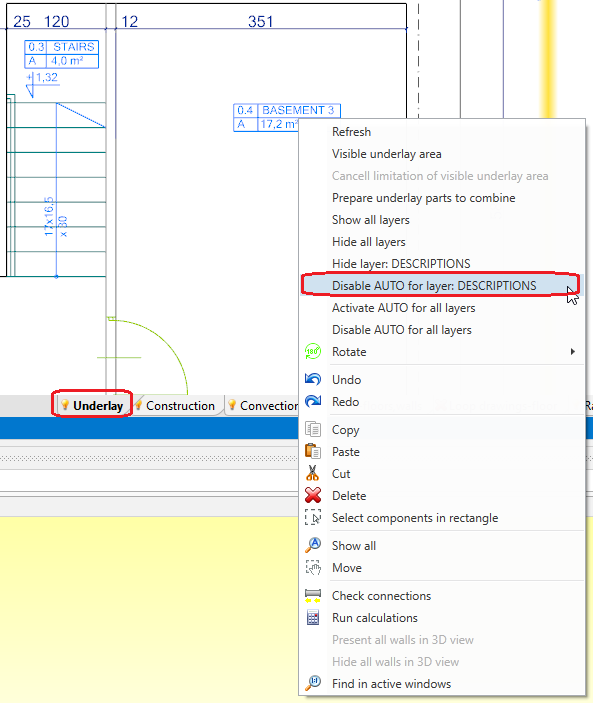
4. Disable AUTO for layer: %s


In the same way, you can chooseDisable AUTO for all layers.
