Sewage installations - Bypass ventilation: Difference between revisions
PR czytacz (talk | contribs) |
PR czytacz (talk | contribs) |
||
| Line 23: | Line 23: | ||
==Location in the program== | ==Location in the program== | ||
In many cases of bypass ventilation the internal structure of stacks structure should be changed. This is achieved by modifying stack data: types of pipes inside, declaration of element on the top, declaration of internal connections, etc. | |||
The type of the stack is indicated in the ''<IS_TS id=DataEditorTable/>''.<br/>[[File:Bypass ventilation location.png|900 px|left|thumb|1. <IS_TS id=typyWlaczenWPionie/>.]]<br clear="all"/> | The type of the stack is indicated in the ''<IS_TS id=DataEditorTable/>''.<br/>[[File:Bypass ventilation location.png|900 px|left|thumb|1. <IS_TS id=typyWlaczenWPionie/>.]]<br clear="all"/> | ||
All necessary points should be specified. | All necessary points should be specified. Some geometrical data (distances between internal connections) have default values, but these may not fit all cases and often require manual correction after observing the 3D model. | ||
==Example of use== | ==Example of use== | ||
Revision as of 12:17, 23 June 2023
| Product | InstalSystem 5 |
| Type of article | FUNCTION AND TOOL |
| Source for translation | 2023-06-21 |
Description
The article describes methods of implementation of various cases of bypass ventilation in sewage installations.
Location in the program
In many cases of bypass ventilation the internal structure of stacks structure should be changed. This is achieved by modifying stack data: types of pipes inside, declaration of element on the top, declaration of internal connections, etc.
The type of the stack is indicated in the Data table.

All necessary points should be specified. Some geometrical data (distances between internal connections) have default values, but these may not fit all cases and often require manual correction after observing the 3D model.
Example of use
The program provides several schemes to perform such types of stacks. Schemes A-D are applicable to buildings from 3 to 5 floors (less or equal to 12m in height). Schema E - for the buildings with more than 5 floors (more than 12m in height)
- Schema A:
- Direct parallel ventilation: vent stack is connected to the sewage stack at the bottom near the stack foot and at the top to the vent cowl;
- Generate intermediate ventilation connections can be made or not depending on the project features.
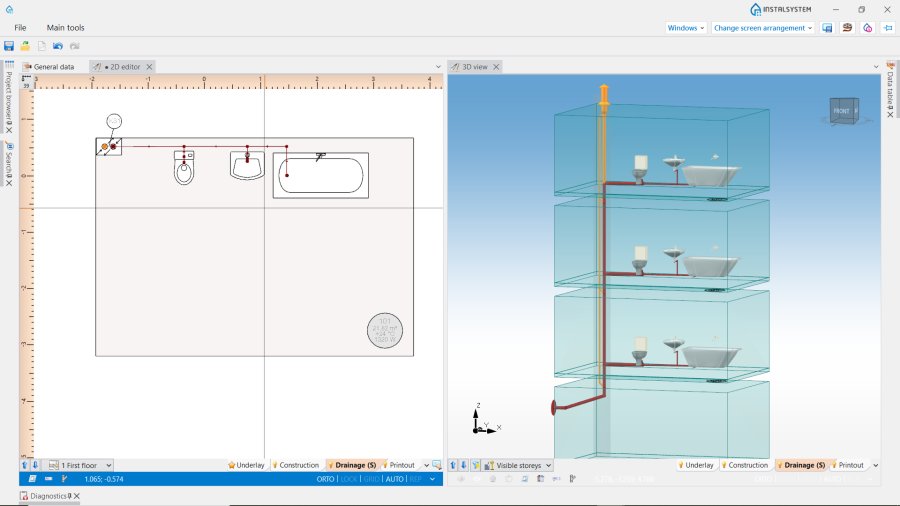
2. Schema A.
- Schema B:
- Indirect parallel ventilation: vent stack is connected to the branches on each floor;
- Air admittance valve is used like an Element on top of stack for both stacks (Sanitary drainage and Ventilation conduit).
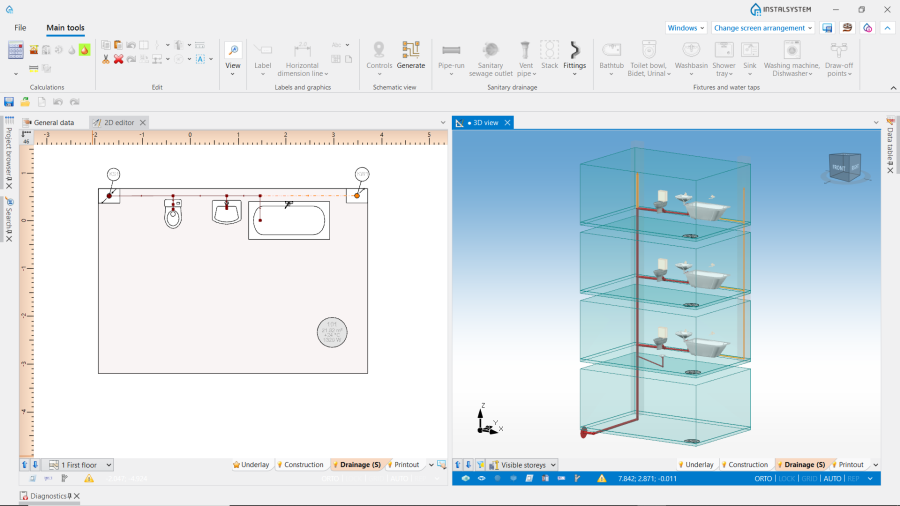
3. Schema B.
- Schema С:
- Direct parallel ventilation: vent stack is connected to the sewage stack at the bottom near the stack foot and at the top to the vent cowl;
- Generate intermediate ventilation connections are made;
- Connection to the vent stack from each fixture on the first floor and from each sewage branch on the floors above.
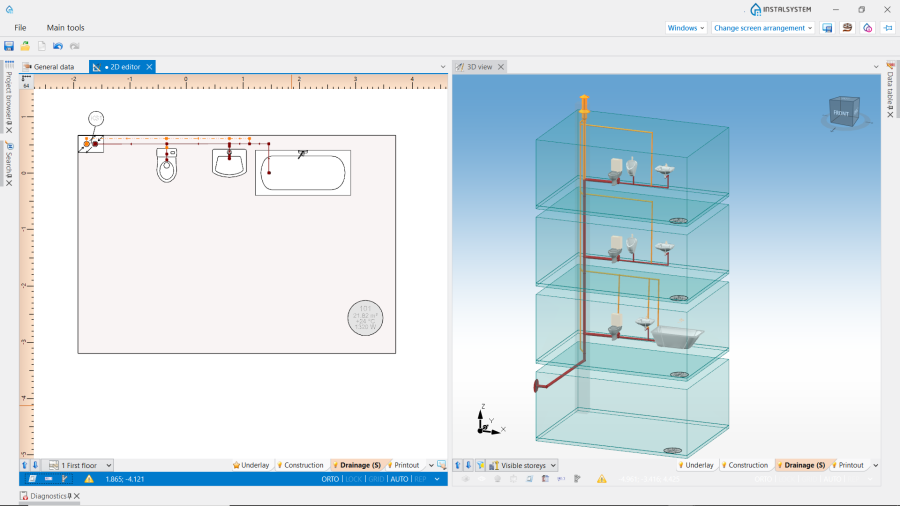
4. Schema C.
- Schema D:
- Air admittance valve is used on the first floor;
- Drainage ventilating pipe-run are connected to the sewage stack on the floors above.
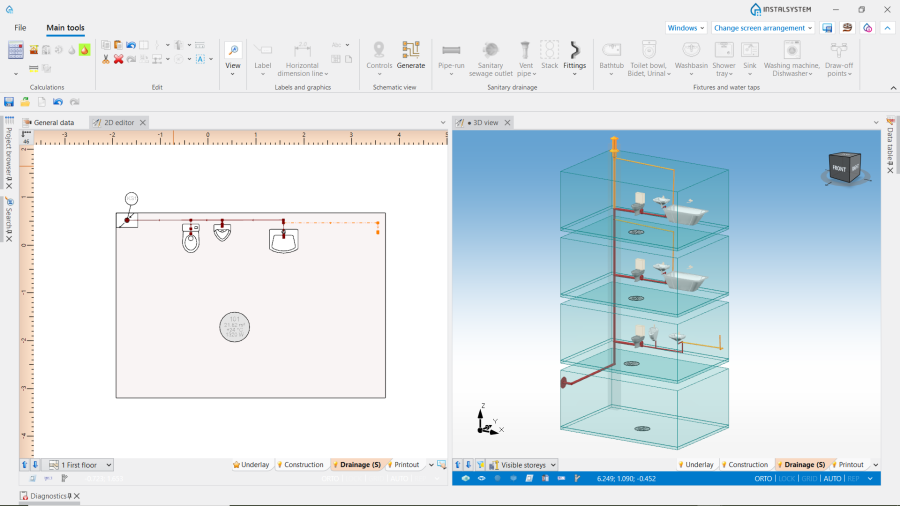
5. Schema D.
- Schema E:
- Direct parallel ventilation: vent stack is connected to the sewage collector. The connection must be made at least 2 m from the base of the stack;
- Generate intermediate ventilation connections should be made;
- Fixtures on the first floor are connected to the additional stack;
- The connection of the additional stack to the main stack is made by the means of a "vent loop".
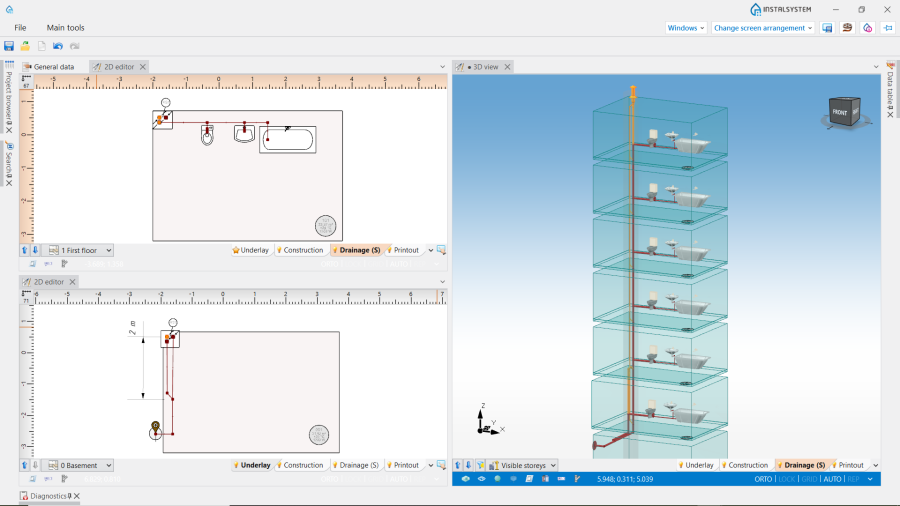
6. Schema E.


