Optimization of the supply temperature of radiant systems
| Product | InstalSystem 5 |
| Type of article | FUNCTION AND TOOL |
| Source for translation | 2025-08-28 |
Description
The program features a unique function that determines the optimal supply temperature for radiant heating systems. The temperature is optimized using proprietary algorithms that consider multiple parameters and their weights. Optimization criteria can be selected from among: heat output and press. drop or min. investment costs. During the calculations, hundreds of configuration options for the system parameters are evaluated to achieve the required heating power.
Location in the program
The Optimize function for the selected control circuit/circuits can be used on theSources tab available in the General data window, or in the Interactive radiant systems calculations window.


Examples of use
Optimization criterion
The user can select the optimization criterion from the following variants:
- heat output and press. drop - the program tries to select a supply temperature that ensures that the thermal efficiency of individual heating/cooling surfaces is as close as possible to the required one, while meeting the overheating/underheating tolerance ranges and maintaining the lowest possible pressure losses.
- min. investment costs - the program tries to select a supply temperature that ensures that the thermal efficiency of individual heating/cooling surfaces is as close as possible to the required one, while minimizing investment costs (which in practice usually means a higher supply temperature).
Criterion for determining the supply temperature
After starting the calculations, the program determines the optimal supply temperature for the indicated control circuit/circuits, taking into account the selected criterion according to the following rules:
- The supply temperature is selected from the <min,max> range specified in the heat source data. The calculations are performed with high precision using a temperature increment of 0.1 K. For each intermediate value of the supply temperature, complete calculations of the radiant heating installation are performed, where the variables are: installation distance, number of loops and cooling of the medium in the loop. First, the preferred spacing configurations are those for which, according to the settings in the Advanced Settings tab, the heating outputs fall within the 'Matching' range. Second priority is given to those classified as 'Moderately Mismatched'. Finally, if no spacing configurations allow for achieving the required heating output (within the entire permissible supply temperature range) within the specified tolerance, the remaining spacing options are considered. In such cases, the heating outputs obtained from the selected or all surfaces may be significantly too high or too low.
- W ten sposób tworzona jest tzw. "Funkcja jakości", prezentowana graficznie na Graph of optimization łamaną.
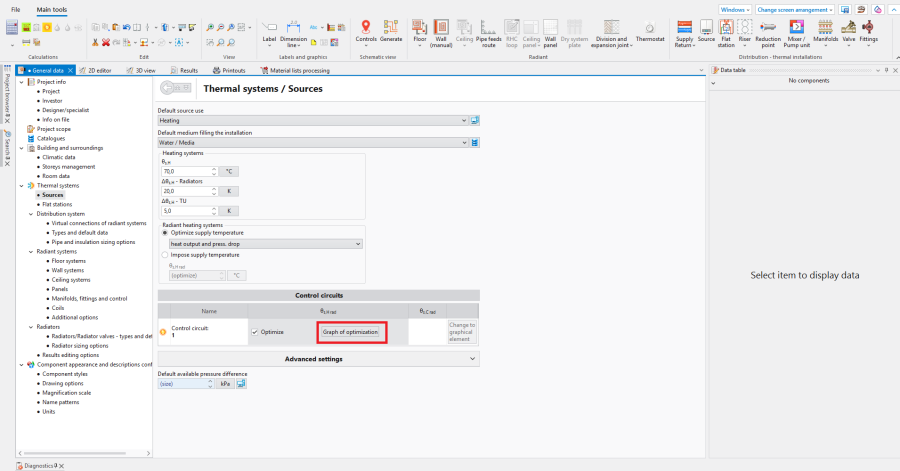
3. Control circuits.
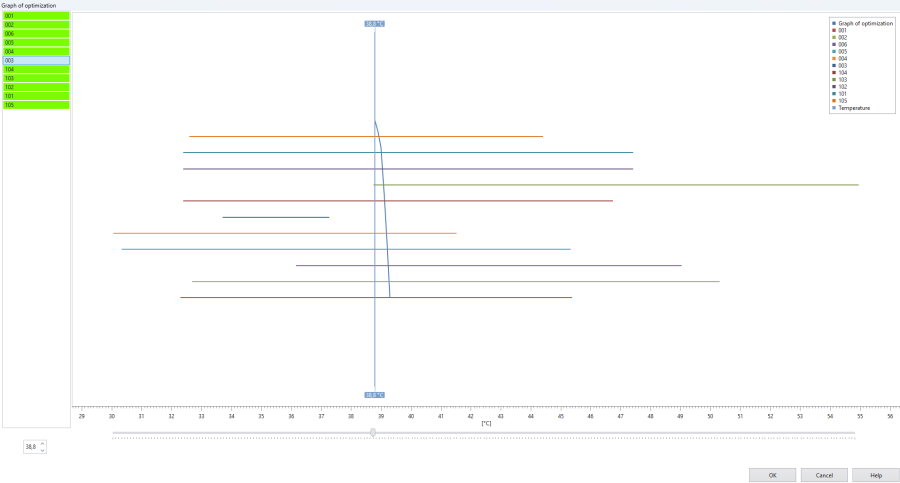
4. Graph of optimization. - Następnie wybierany jest punkt o najlepszej wartości funkcji jakości (najwyższy na Graph of optimization). W przypadku, gdy wiele temperatur wykazuje taką samą maksymalną wartość funkcji jakości (z uwzgl. pewnej tolerancji), program wybiera najniższą z nich.
- Przebieg funkcji jakości zależny jest też od wybranego wariantu optymalizacji temperatury zasilania:
- Dla kryterium heat output and press. drop brane są pod uwagę głównie parametry wpływające na komfort użytkowania tj. możliwość uzyskania niższej temperatura podłogi, ale także teoretycznie możliwość zmiany okładziny na inną.
- Dla kryterium min. investment costs oprócz parametrów wpływających na komfort użytkowania uwzględniane są również koszty inwestycyjne. Stąd preferowane są rozwiązania dające większe odstępy układania oraz np. możliwość zastosowania rozdzielacza o mniejszej ilości obwodów.
- Jest możliwe uzyskanie identycznej wartości temperatury zasilania dla obydwu kryteriów optymalizacji, ale najczęściej wówczas program dobierze inne wartości odstępu układania. Wynika to z faktu, że funkcja jakości temperatury dla obydwu kryteriów ma inny przebieg, ale jej maksimum może być w tym samym punkcie. Jednak przy tej samej wartości dla kryterium min. investment costs program dobierze większą wartość odstępu układania, aby zmniejszyć sumaryczną długość rury.
- Możliwe jest uzyskanie komunikatu błędu o braku możliwości wyznaczenia temperatury zasilania (np. w przypadku za wysokich wartości wymaganej mocy względem możliwości systemu). Wówczas program przyjmuje wartość maksymalną określoną dla danego obwodu regulacji (źrodła/mieszacza/ZPM).

