Optimization of the supply temperature of radiant systems: Difference between revisions
Switalskia (talk | contribs) |
Switalskia (talk | contribs) |
||
| Line 43: | Line 43: | ||
# The course of the quality function also depends on the selected variant of supply temperature optimization: | # The course of the quality function also depends on the selected variant of supply temperature optimization: | ||
#* For the ''<IS_TS id=sOptymalizacjaCieplnaIHydr/>'' criterion, the parameters mainly affecting user comfort are considered, i.e., the possibility of achieving a lower floor temperature, but also theoretically the possibility of changing the floor covering. | #* For the ''<IS_TS id=sOptymalizacjaCieplnaIHydr/>'' criterion, the parameters mainly affecting user comfort are considered, i.e., the possibility of achieving a lower floor temperature, but also theoretically the possibility of changing the floor covering. | ||
#* | #* For the ''<IS_TS id=sOptymalizacjaMinimalizacjaKosztow/>'' criterion, in addition to the parameters influencing user comfort, investment costs are also taken into account. Hence, solutions that allow for larger pipe spacing and, for example, the use of a manifold with fewer circuits are preferred. | ||
# | # It is possible to obtain an identical supply temperature value for both optimization criteria, but most often the program will then select different values of pipe spacing. This results from the fact that the quality function for temperature behaves differently for the two criteria, although its maximum may occur at the same point. However, for the same value under the ''<IS_TS id=sOptymalizacjaMinimalizacjaKosztow/>'' criterion, the program will select a larger spacing in order to reduce the total pipe length. | ||
# | # An error message may occur indicating that it is not possible to determine the supply temperature (e.g., if the required heating capacity is too high compared to the system’s capability). In such a case, the program adopts the maximum value defined for the given control circuit (source/mixing valve/ZPM). | ||
[[Category:InstalSystem 5]] | [[Category:InstalSystem 5]] | ||
Revision as of 15:40, 2 September 2025
| Product | InstalSystem 5 |
| Type of article | FUNCTION AND TOOL |
| Source for translation | 2025-08-28 |
Description
The program features a unique function that determines the optimal supply temperature for radiant heating systems. The temperature is optimized using proprietary algorithms that consider multiple parameters and their weights. Optimization criteria can be selected from among: heat output and press. drop or min. investment costs. During the calculations, hundreds of configuration options for the system parameters are evaluated to achieve the required heating power.
Location in the program
The Optimize function for the selected control circuit/circuits can be used on theSources tab available in the General data window, or in the Interactive radiant systems calculations window.


Examples of use
Optimization criterion
The user can select the optimization criterion from the following variants:
- heat output and press. drop - the program tries to select a supply temperature that ensures that the thermal efficiency of individual heating/cooling surfaces is as close as possible to the required one, while meeting the overheating/underheating tolerance ranges and maintaining the lowest possible pressure losses.
- min. investment costs - the program tries to select a supply temperature that ensures that the thermal efficiency of individual heating/cooling surfaces is as close as possible to the required one, while minimizing investment costs (which in practice usually means a higher supply temperature).
Criterion for determining the supply temperature
After starting the calculations, the program determines the optimal supply temperature for the indicated control circuit/circuits, taking into account the selected criterion according to the following rules:
- The supply temperature is selected from the <min,max> range specified in the heat source data. The calculations are performed with high precision using a temperature increment of 0.1 K. For each intermediate value of the supply temperature, complete calculations of the radiant heating installation are performed, where the variables are: installation distance, number of loops and cooling of the medium in the loop. First, the preferred spacing configurations are those for which, according to the settings in the Advanced Settings tab, the heating outputs fall within the 'Matching' range. Second priority is given to those classified as 'Moderately Mismatched'. Finally, if no spacing configurations allow for achieving the required heating output (within the entire permissible supply temperature range) within the specified tolerance, the remaining spacing options are considered. In such cases, the heating outputs obtained from the selected or all surfaces may be significantly too high or too low.
- This process generates the so-called 'quality function', which is graphically represented as a polyline on Graph of optimization.
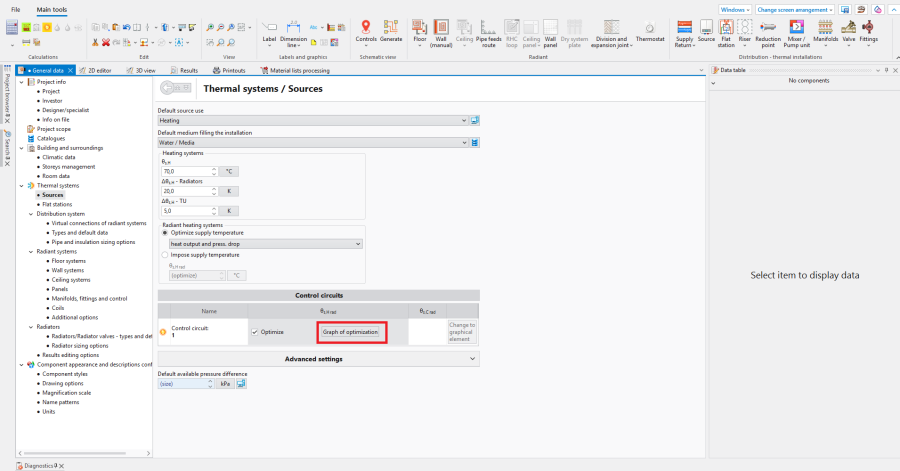
3. Control circuits.
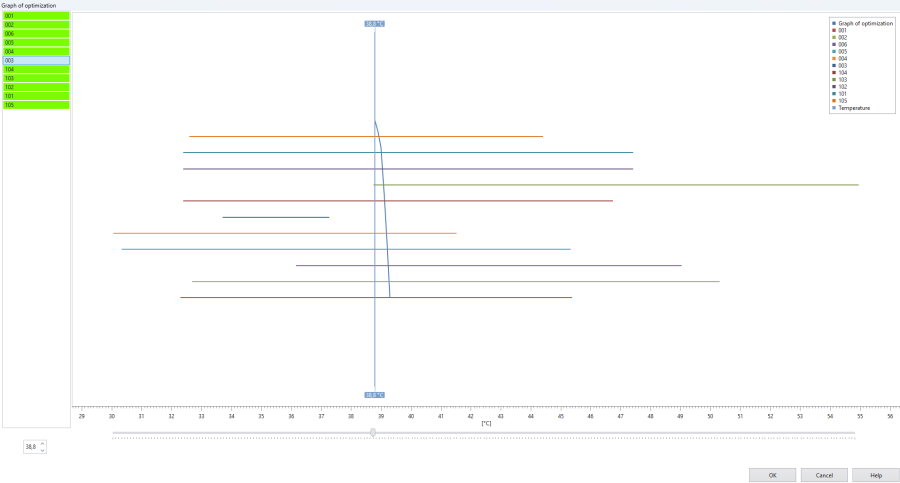
4. Graph of optimization. - Next, the point with the best value of the quality function is selected (the highest on the Graph of optimization).). In the case where multiple temperatures yield the same maximum value of the quality function (within a certain tolerance), the program chooses the lowest of them.
- The course of the quality function also depends on the selected variant of supply temperature optimization:
- For the heat output and press. drop criterion, the parameters mainly affecting user comfort are considered, i.e., the possibility of achieving a lower floor temperature, but also theoretically the possibility of changing the floor covering.
- For the min. investment costs criterion, in addition to the parameters influencing user comfort, investment costs are also taken into account. Hence, solutions that allow for larger pipe spacing and, for example, the use of a manifold with fewer circuits are preferred.
- It is possible to obtain an identical supply temperature value for both optimization criteria, but most often the program will then select different values of pipe spacing. This results from the fact that the quality function for temperature behaves differently for the two criteria, although its maximum may occur at the same point. However, for the same value under the min. investment costs criterion, the program will select a larger spacing in order to reduce the total pipe length.
- An error message may occur indicating that it is not possible to determine the supply temperature (e.g., if the required heating capacity is too high compared to the system’s capability). In such a case, the program adopts the maximum value defined for the given control circuit (source/mixing valve/ZPM).

