This article was prepared based on the InstalSystem software package. Equivalent functionalities are also available in the other packages listed in the "Product" field in the table above.
The program provides the opportunity to export / print drawings and results in both 2D and 3D formats.
Drawings / graphical printouts can be exported to:
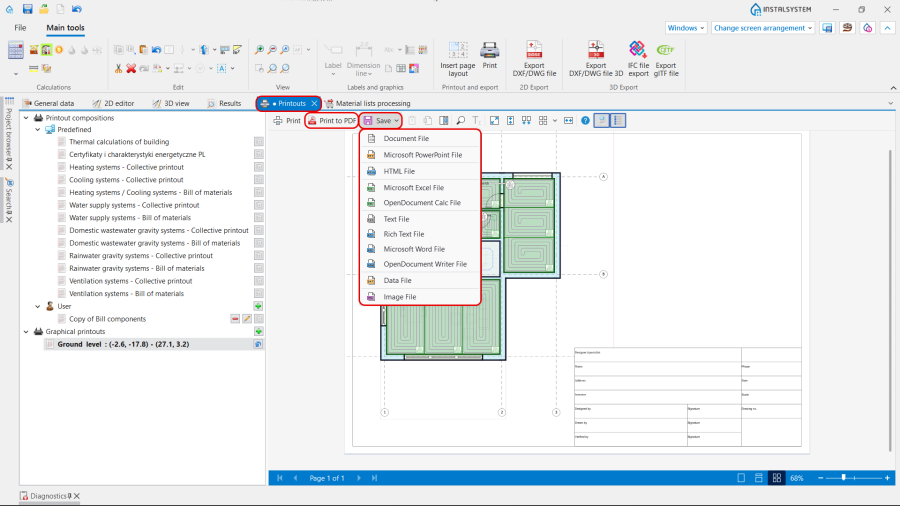
Note: Export to DWG / DXF, DWG(3D) / DXF(3D), IFC4, glTF, PDF(3D) and WebGL files is performed using dedicated functions, whereas exporting to other file formats is done using Print functions. This process involves printing to a file of the selected type.
Location in the program
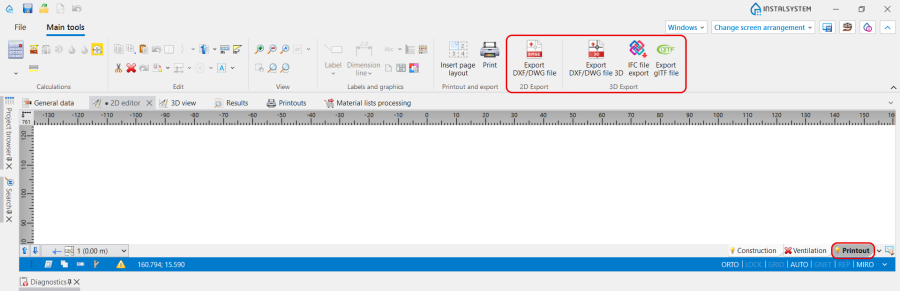
The icons with functions related to 2D Export and 3D Export are located on the Main tools bar when the Printout editing scope is active. The functions enable exporting graphics from the project file. 1. 2D Export and 3D Export functions location.
Printing and exporting to file formats are performed in the Printouts window. The Print function, available on the Main tools bar when the Printout editing scope is enabled, switches the program to that window. Alternatively this can be done by calling this window from the Windows menu on the Main tools bar. 2. Print functions location.
Results can be printed or exported using Printout compositions - either predefined or defined by the User. User-defined and saved Printout compositions, in addition to Predefined, will also be available in other projects. For more information, see:Printout compositions;
Drawings can be printed or exported using Graphical printouts.
Note: To create Graphical printouts the Printout pages component needs to be inserted on the drawing. Every such component is a new definition of the scope of printout / export of graphics. Inserting Printout pages can be done with the use of Add function in the Printouts window:
3. Add Printout pages.
or Insert page layout function, available on the Main tools bar when the Printout editing scope is active.
4. Insert page layout.
The Results tables can also be printed and exported separately in the Results window:
5. Export / print Results tables.
Bill of materials can be exported in GAEB 81, UGS, ISB and CSV formats in the Material lists processing window:
6. Export Bill of materials.
Example of use
Preparation drawings for exporting / printing
Insert Printout pages component. Adjust its settings to meet the project requirements:
Paper format,
Orientation,
Scale,
Margins;
Insert Drawing chart. For more information, see:Drawing chart.
Exporting 2D drawings to DXF / DWG formats
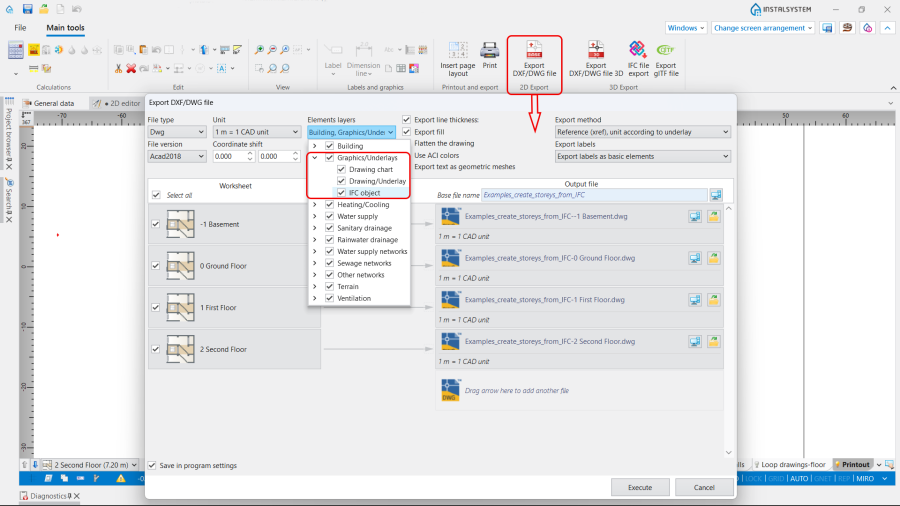
To export 2D drawings to DXF / DWG formats use Export DXF/DWG file function. The following settings can be modified in the Export table:
Visibility of Elements layers and their components. Note: There is an option to change the visibility of IFC object elements underlay export, if they are present in the project. 7. IFC object underlay export visibility.
Usage of the function Export text as geometric meshes - Converts all text to geometric meshes. This option may prevent export errors related to unsupported fonts.
Export method,
Indicating of exporting Worksheet elements by separate selection or Select all function,
Selection of Output file:
Several Worksheet elements can be exported to a single file,
Base file name can be modified,
The export location can be changed (by default, files are saved in the folder containing the calculation file).
Note: It is possible to Save in program settings the modified settings.
Exporting 3D drawings
To export 3D models to DXF / DWG formats use Export DXF/DWG file 3D function. The settings can be modified in the Export table in the similar way as for 2D exporting drawings to DXF / DWG formats. Note: Access to the function depends on the availability of the relevant IFC (BIM) export modules.
To export 3D models to glTF, PDF(3D), WebGL formats use Export glTF file function. The settings can be modified in the Export table in the similar way as for 2D exporting drawings to DXF / DWG formats. Note: Access to the function depends on the availability of the relevant IFC (BIM) export modules. File:Export print results and drawings Export glTF.png8. 3D Export in glTF, PDF(3D), WebGL formats.
Printing drawings with a defined range of storey levels
If the building contains Internal storey level or Additional storey level the program provides the option to set the range of storey levels to be printed:
Uncheck the boxes of Elements layers for the main storey or Element layers from an additional storey/levels OR
Specify the Print levels range;
Verify the Graphical printouts in the Printouts window, Refresh if necessary.
Exporting results to PDF, XLSX and DOCX formats
Export separate Results tables or PredefinedPrintout compositions;
Create defined by the UserPrintout compositions, if necessary.
Additional information
When underlay drawing was imported with the Save underlay drawing -> In external file option and original location of the file is not available, the underlay layers cannot be exported. In such case, in order to have the underlay drawing included in the export or printout, it must be loaded again. For more information, see:Import underlay files.
Adding supplementary drawing information before exporting / printing
Once all required changes have been made to the project and calculations have been completed, elements that complement the information provided in printouts can be entered into the project. These elements are of informative nature and do not affect the course of calculations. Inserting them into the project only at this stage is recommended, as iterative work with the project in earlier stages may also require modification of these elements. Therefore, inserting them in the final stage of work may be most effective. Details of the types of elements available for specific types of installations can be found in the program application descriptions.
For more information, see:DESIGN APPLICATIONS.
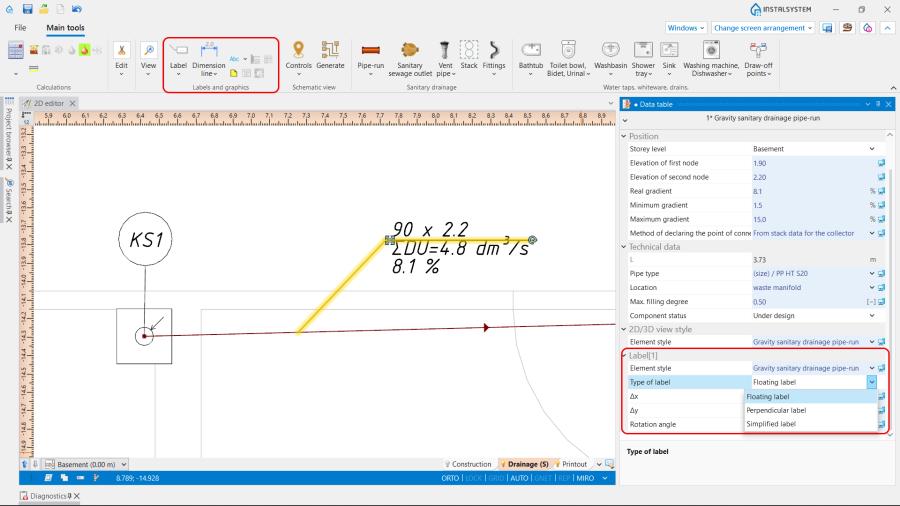
Component labels, available in the Main tools bar in the Labels and graphics section, are an example of such elements. A label is inserted by selecting the appropriate icon from the toolbar and clicking on the drawing component for which the label is intended. When a component with a label is selected in the drawing, the label style can be selected in the Data table window. 9. Component Label. Label styles are customizable. It is possible to create and save many user-defined label styles. For more information, see:Component appearance configuration.
If you have any comments on this article, please send us a short message at info@instalsoft.com.